From Silence to Proactive Sharing: The Journey to Empowering Female Workers' Voices
VCCI-HCM’s training and consulting program has helped enhance communication skills, confidence, and the role of female workers in shrimp and rice processing enterprises in the Mekong Delta, contributing to fostering an equitable, innovative, and sustainable working environment.
PDF Document
Use the browser PDF zoom controls to enlarge the document.
Introduction
In shrimp and rice processing enterprises, where the majority of the workforce consists of women, female workers play a crucial role and generate value for the development of the sector. In the context of international markets such as the EU, the US, and Japan increasingly paying attention to working conditions, fulfilling social responsibility, and empowering female workers, enterprises are required to enhance the role and voice of female employees within their organizations.
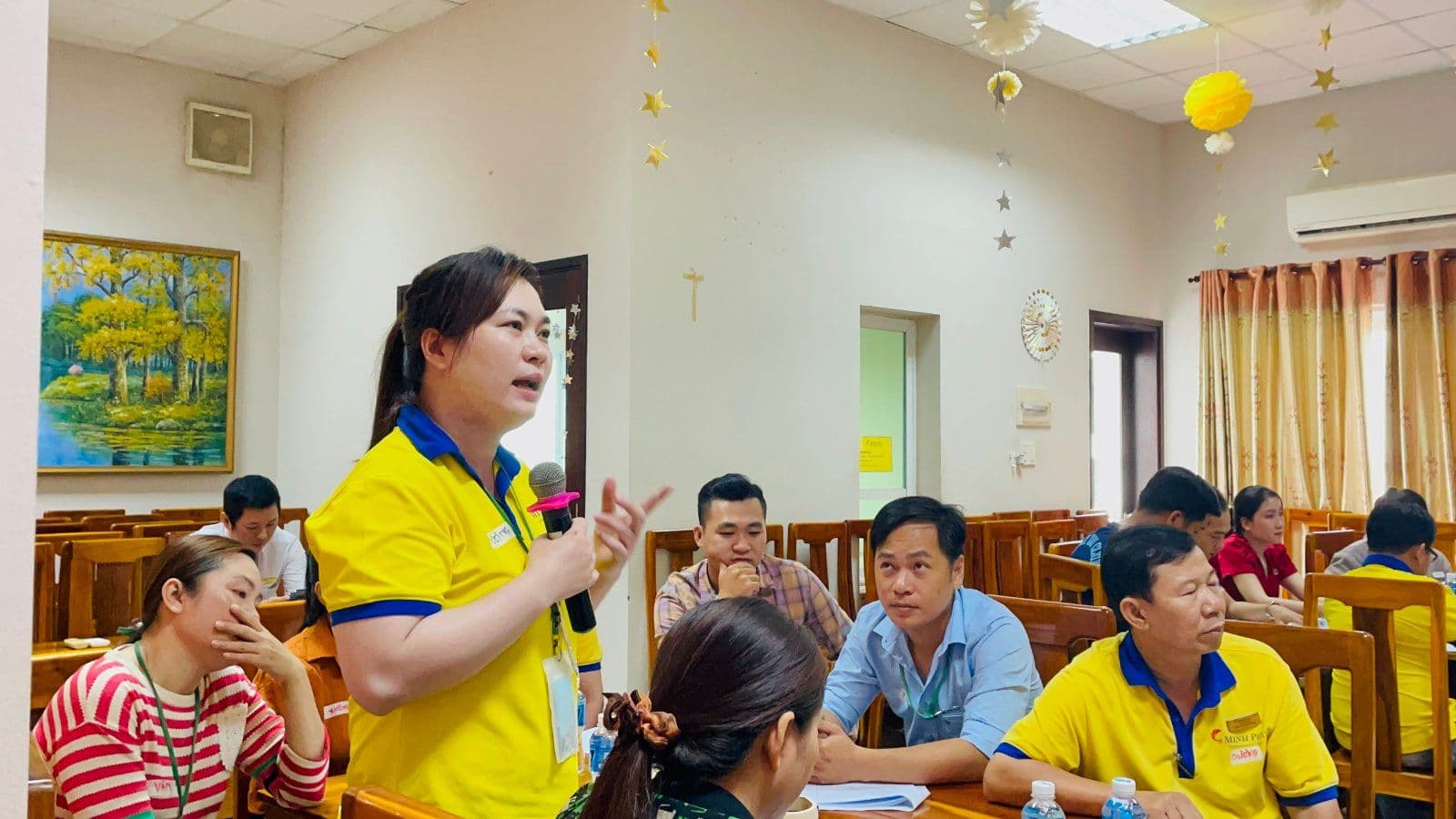
However, a reality exists where female workers in shrimp and rice processing enterprises in the Mekong Delta are often hesitant to share and contribute ideas during meetings. Recognizing this barrier, through the DGD program, VCCI-HCM has developed training and business consulting activities in the shrimp and rice processing sectors to build the capacity of the workforce, especially female workers. Through training courses on communication skills, presentation skills, and problem-solving skills, along with consulting programs on hazard identification, waste identification, and continuous improvement implementation, female workers in shrimp and rice processing supply chains have been equipped with knowledge and skills, while also having the opportunity to become more open and confident in their communication. The training and advisory programs consistently adopt a learner-centered approach; through teamwork, discussions, and problem-solving, workers have the opportunity to exchange and share ideas with colleagues and upper management to address ongoing workplace issues.
As confidence increases, female workers also elevate their roles and voices across enterprise activities. When empowered with professional knowledge and skills, female employees proactively and confidently contribute their ideas and initiatives in daily operations, thereby fostering a friendly and diverse working environment. This impact extends beyond the enterprise level: through learning and actively voicing their perspectives, female workers unlock their personal potential and capabilities, contributing to a community of confident, proactive women who actively contribute to society.
For enterprises, encouraging worker participation and fostering a fair, innovative, and cohesive work environment also helps businesses attract and retain talent. Amid the growing trend of responsible business conduct, this represents an opportunity for enterprises to fulfill their corporate social responsibility and promote gender equality, driving the sustainable development of enterprises within the shrimp and rice value chains.
Through the DGD program, building upon good practices from training programs at Minh Phu Seafood Corporation, VCCI-HCM has scaled up the organization of training programs for other businesses in the shrimp and rice chains, such as Khang An Foods JSC, Binh Tay Food JSC, Taky Food Ingredients JSC, Vinh Hien Rice JSC, and others.
By the end of 2025, VCCI-HCM had delivered training and consulting services to over 1,000 female workers across enterprises, covering key topics:
Over 50 training courses on communication skills, presentation skills, and problem-solving skills.
Over 30 training courses on occupational safety and health (OSH), hazard identification, and safety improvement planning.
Over 10 training courses on production management skills.
12 in-depth training and consultancy programs on improving workplace conditions, ranging from waste identification and action planning to implementing 5S and Kaizen to improve production.
“Through the course, I found it very beneficial for myself as well as my colleagues to acquire more skills to communicate with workers. When returning to the workshop, I will share and pass on the knowledge I have learned to the workers so that we can work better together,” shared Ms. Le Kim Thoa – Production Supervisor.
“At the beginning of the course, I felt limited in speaking before a crowd. But after the two-day course on communication skills, I feel I have made significant progress in speaking in front of people, which also supports me greatly in communicating with my supervisors and colleagues,” shared Ms. Le Lam Xuan – Quality Control (QC/KSC) Staff.